


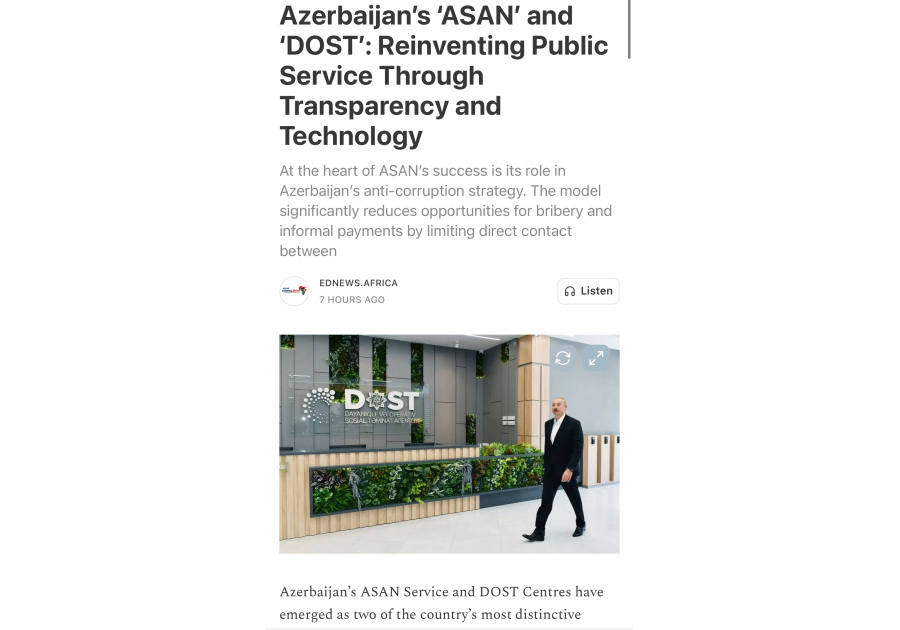

South Africa’s Independent Online (IOL) and EDNews Africa have published an article titled “Azerbaijan’s ASAN and DOST: Reinventing public service through transparency, technology” highlighting Azerbaijan’s ASAN Khidmet model and DOST centers, which have emerged as two of the country’s most distinctive public sector innovations, transforming the delivery of government and social services through technology, transparency and citizen-focused governance.
“Together, they have helped redefine the relationship between citizens and the state by simplifying access to services, reducing bureaucracy and strengthening accountability.
Established in 2012 at the initiative of President Ilham Aliyev, ASAN Khidmet was introduced as part of wider institutional reforms aimed at modernising public administration. Built on a one-stop-shop concept, ASAN enables citizens to access a broad range of government services in a single location, eliminating the need to visit multiple offices and navigate complex procedures.
Today, ASAN centres provide more than 400 services delivered by 15 public institutions and 30 private organisations. The network has expanded to 28 centres across Azerbaijan, processing more than 91 million applications since its inception. Citizen satisfaction stands at 99.8%, reflecting the system’s emphasis on efficiency, accessibility and service quality,” the article said.
According to the report, transparency is embedded throughout the system.
“Service processes are digitally tracked, queue management technologies monitor service delivery, and centre designs incorporate glass-walled layouts that allow for public visibility.
These measures are complemented by innovative technological platforms developed to manage and improve operations, including electronic document management, business intelligence reporting, human resources systems, monitoring and evaluation tools, the ASAN Payment System and the ASAN Appeal System.
Recognising that some citizens live far from permanent service centres, the State Agency for Public Service and Social Innovations (SAPSSI) introduced mobile ASAN Khidmet units. Operating through ten specially equipped buses, these mobile centres travel to remote regions according to predetermined schedules, bringing essential government services directly to underserved communities,” the article mentioned.
“Beyond direct service delivery, SAPSSI has expanded its public engagement efforts through ASAN Radio and ASAN TV. These dedicated media platforms promote transparency, raise awareness of public services and encourage greater civic participation.
Over time, ASAN Khidmet has developed into what Azerbaijani officials describe as a national intellectual product. Its reputation has grown internationally, attracting interest from governments seeking more effective ways to deliver public services. SAPSSI has signed more than 30 memoranda of understanding and cooperation agreements with countries and international organizations interested in learning from or adapting the model.
Partnerships have been established with institutions in countries including Romania, Türkiye, Indonesia, Pakistan, Ethiopia, Montenegro, Morocco, Uganda, Uzbekistan, Kyrgyzstan, Kazakhstan, Senegal, the United Arab Emirates, the Republic of Korea and Guinea-Bissau. Several countries, including Uganda, Uzbekistan, Afghanistan, Indonesia and Ethiopia, who have already adopted elements of the ASAN model to improve public service delivery.
The Kingdom of Eswatini has also expressed interest in receiving technical assistance and expertise for establishing ASAN Khidmet and DOST Centers. Such cooperation highlights growing international recognition of digital governance solutions that improve efficiency and accessibility in the public sector.
The article highlighted that the success of ASAN Khidmet laid the groundwork for another major reform initiative: the DOST Agency. Established in 2018, DOST was designed to apply the same principles of transparency and efficiency to social protection services.
“The Agency for Sustainable and Operative Social Provision, known as DOST, provides services through dedicated DOST Centers operating under a framework determined by the President of Azerbaijan. The system standardizes more than 160 social protection and labor-related services, reducing paperwork and limiting opportunities for abuse.
The agency’s mandate extends beyond service delivery. It conducts surveys among people requiring social protection, studies their concerns, develops proposals aimed at protecting their rights and participates in drafting legislation relevant to its field. It also reviews appeals submitted under laws governing citizens’ appeals, administrative proceedings and access to information.
Together, ASAN Khidmet and DOST Centers represent a comprehensive effort to modernize governance in Azerbaijan. By combining technology, transparency and citizen-centered design, the two initiatives have streamlined public administration, strengthened accountability and expanded access to essential services.
In doing so, they have become national brands and internationally recognized examples of how public service reform can transform the relationship between citizens and the state,” the article concluded.